
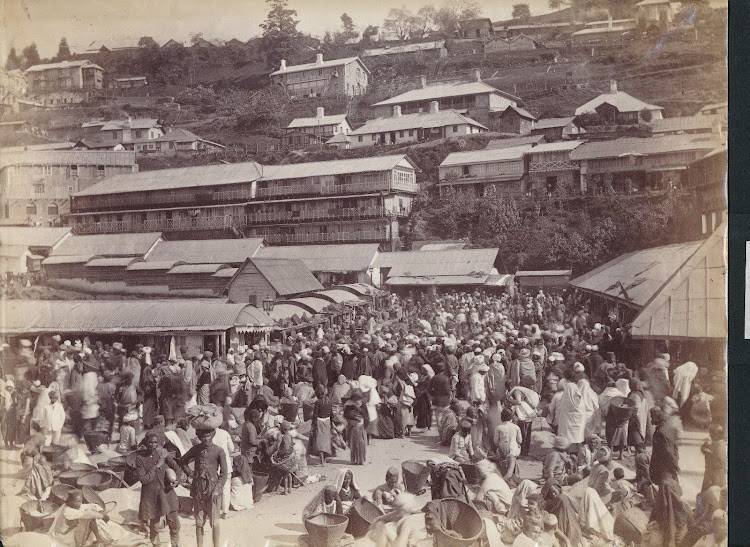
Trade became a major form of economic activity in Darjeeling. The Strategic importance of Darjeeling led to the growth of trade and commerce in the region. The primary motive of the British in establishing Darjeeling as a hill station was to exploit the trans-Himalayan trade with Tibet, Nepal, Bhutan, and eventually Sikkim. Trade and Commerce moulded the socio-economic developments of the Darjeeling hills.
Background of trade and commerce in the Darjeeling hills:
In 1768, the Court of Directors in London discussed the prospect of trade with the countries of the Himalayan region through Nepal. For a long time, they were in search of a suitable place through which trade in the trans-Himalayan region could be conducted without many obstacles. Therefore, due to the strategic importance of Darjeeling, the British Government developed Darjeeling both for defensive and commercial lines. The Treaty of Titalya (1817) with Sikkim won the British important trading rights. The primary aim of the treaty was to strengthen the position of the East India Company in a Himalayan area, which would offer magnificent prospects for opening a route for British trade to reach Tibetan markets. They made efforts to improve communications.
Strategic and Commercial importance of the Darjeeling hills:
The economic potentiality and the prospects of trade, and the strategic importance of Darjeeling contributed to its identity as a hill station. The closeness of the international borders has made Darjeeling strategically important. On all grounds, Captain Lloyd strongly urged the need to secure possession of the place. He pointed out its advantages as a trade center and as a position of great strategical importance, commanding the entrance into Nepal and Bhutan. Climate was not only the sole factor for the cession of Darjeeling and they concealed the primary interest, i.e. development of Darjeeling as a trade route to Tibet. Dr. Campbell promoted trade and commerce. Indeed, throughout the second half of the nineteenth century, commercial interests and strategic considerations of the British Government shaped the destiny of Darjeeling.
Trans-Himalayan Trade and Darjeeling:
Trans-Himalayan Trade between Tibet and the East India Company was the primary motive of the British. Captain (Lloyd) included, they could develop the roads to Darjeeling with tea cultivation, settlement of Indian merchants, and the construction of a native Bazar. Therefore, the climate was not only the sole factor for the cession of Darjeeling and they concealed the primary interest, i.e. development of Darjeeling as a trade route to Tibet.
W.B. Jackson of the Bengal Civil Service submitted an encouraging report on the trade between Darjeeling and Tibet, published in 1854. The Calcutta Review published an account of the trade of Darjeeling. Hyde Clarke highlighted the development and importance of the hill station (Darjeeling), not only as a health resort but also for Transfrontier commerce and defense of the northern frontier of India.
Through Darjeeling is the shortest mountain passage across the Himalayas into Tibet and Central Asia, and they could establish large commerce in British manufactures for these countries. In 1861, they concluded a treaty at Tumloong, the then capital of Sikkim. Ashley Eden signed a treaty with the new Raja. From 1861 onwards the trade and commerce in the Darjeeling hills, i.e., Darjeeling sub-division and later Kalimpong (1866) played a remarkable role in the socio-economic conditions of the region. From 1861, the frontier trade gained momentum with no disturbances and Darjeeling became an important trade centre. In 1890, an Anglo-Chinese Convention defined the boundary between Sikkim and Tibet, and three years later a supplementary trade agreement was added to this Convention.
However, the British Legacy of trade and commerce between the Darjeeling hills and Tibet declined after the occupation of Tibet by China in 1959. The Indo-Chinese War of 1962 affected further it.
Role of Transport and Communication:
Roads and railways were constructed to encourage trade and commerce. The opening of the Northern Bengal State Railway in 1878 and of the Mountain Railway in 1880 and the resulting facilities for transporting the tea to Calcutta gave an immense stimulus to this great industry. Lt.Governor Sir Ashley Eden named the Darjeeling Steam Tramway co.; They changed it to ‘The Darjeeling Himalayan Railway co. in 1881. The railway had a monopoly over the imports and export trade of Darjeeling town and the hill areas of the district. The principal commodities moved by the Railway on the mainline are rice and food grain, cement, iron, salt, and building materials, coal, provisions, and miscellaneous merchandise in the upward direction, and potatoes, tea, cardamoms, oranges, and timber in the downward direction.
The Kalimpong ropeway Co. Ltd. was formed in 1928 for the transportation of commodities from the Kalimpong town to the Darjeeling Himalayan railway over the Teesta valley. Similarly, the ropeway from Darjeeling to Bijanbari, 5 miles long, was owned by Darjeeling ropeway Co. Ltd. and opened for traffic in January 1939. There were also several private ropeways on different tea gardens, such as Lisa Hill, Thrubo, Gopaldhara, Namring, Pashok, Gyabari, Phuguri, and Singball estates.
The Darjeeling-Bijanbari ropeway opened in 1939. The Bijanbari- Darjeeling ropeway competes with a bridle path route via Pul Bazar of an estimated length of 8 miles. It connected Bijanbari, an important trade centre from eastern Nepal, and western Sikkim with Darjeeling. The only other Ropeway, opened after independence, connects Darjeeling with Shingla Bazar with a carrying capacity of 4,000 tons of goods and 10000 passengers per year. Thus, the Ropeway proved to be an efficient and commercial form of transport.
The emergence of Kalimpong as a trading post:
Kalimpong, the sub-division of colonial Darjeeling, became popular as it served as the important trading centre for Indo-Tibetan trade. Kalimpong played a vital role in lucrative trans-Himalayan trade via Jelep-la. In the nineteenth century, Kalimpong‘s importance increased as its proximity to the British leisure capital of Darjeeling and to the accessible cross-Himalayan passes of Nathu-la and Jelep-la led to its unprecedented exposure. It grew considerably in size and influence after 1904 when the Anglo-Tibetan Treaty signed between British imperial representative Younghusband and the Tibetan Government in Lhasa led to the opening of several trade markets to facilitate the circulation of British goods and Tibetan and Himalayan commodities into broader imperial trade networks.
Kalimpong was known for its wool trade, but also as a center for the exchange of other Tibet- sourced items, such as furs, salt, musk, and borax, with global commodities brought through the routes of empire. Kalimpong received wool from Tibet to despatch it to Calcutta after sorting and bailing in warehouses in Kalimpong Bazar and Calcutta in its turn exported it to Liverpool.
Before the Chinese state sealed its borders with Nepal and India in the early 1960s, Tibetans and other ethnic groups living at the two sides of the mountain range had for centuries moved back and forth, involved in trade, pilgrimage, and other forms of trans-Himalayan exchange.
The commerce of Darjeeling reduced to small local businesses, i.e., collection and distribution of commodities, despite that, Darjeeling stands as an essential tourists resort and tea-producing zone and cross-cultural connection fostered by trade has an influence on food habits, religion, and demography.
Very Informative. Congratulations and thank you for your effort.
Gteat work Dada informative Dada keep going.
Wonderful informational history about this beautiful✨❤ place. Keep writing ✍️.
Good information, please write about the different time zone observed by the locals in those area and the rest of India.
Appreciate the work.
Informative, indeed. Thank you for he write up.
Informative. Really loved reading the history of my homeland.